
Between our two Co-Founders, Gareth Brown and Andrew (Drew) Brunskill, they've been working on the same renewables questions for over two decades:
-
How much will a renewable asset actually produce?
-
What's the uncertainty on that prediction?
-
Where are things going to fail?
-
And what can owners do to ensure a strong ROI on their assets?
Gareth began his career in the industry in 2005 in the attic of a church in Glasgow, then worked across India, China, Sri Lanka and North America at an independent engineering firm advising investors, banks and insurers. Drew came into the industry in 2010 as a mechanical engineer running analysis on wind and solar farms. They worked together as independent engineers before founding Clir in 2016.
That history matters. Predictions made before a renewable asset is built have to survive contact with operational reality for the rest of the asset's life. As Gareth puts it bluntly, "these assets generally don't do what they say on the tin." Closing that gap between what owners expect and what their portfolios actually deliver is the problem Clir was built to solve.
Gareth and Drew recently sat down with Adam on the Watts Up Renewables podcast to talk about where AI is changing the math and what they've learned from putting Clir's platform on over 350 GW of operational wind, solar and battery storage. Four ideas came out of that conversation.
1. Offtake Exposure Is a Technical Risk in Disguise
When people in the industry talk about asset optimization, they lean heavily into production. Point the turbines into the wind. Get them pitching and yawing at the right times. Watch for soiling on the solar panels. Make sure the trackers are doing what they're supposed to do. All of that matters.
Gareth made a point on the podcast that often surprises owners. "The biggest cause of financial catastrophe on a renewable energy asset is getting the offtake wrong," he said.
Clir had an asset in Texas that lost around $80 million in roughly two weeks because the operator had committed to producing volumes the turbines couldn't deliver at the times the market needed them. Drew shares his perspective how modeling done at preconstruction doesn’t always match the reality of real-world conditions.
"When preconstruction modeling doesn’t accurately reflect what will actually happen, operators can potentially lose money due to underperformance. Our software and data are used to look at portfolios through a second lens using real data to provide more accurate outputs."
The same dynamic plays out in Scandinavia, Gareth said, where day-ahead commitments meet ice storms. Every wind farm in the region gets hit at the same time. No one can produce. Operators have to go back to the power market and buy at much higher prices to cover their commitments. A profit built up over a year or two can disappear in a single low-frequency event.
Technical underperformance and offtake exposure are really the same conversation. An asset that can't produce what its contracts assume forces the owner to take on market risk they never priced for, on top of the lost generation revenue. The technical performance of the asset and its financial risk are the same question.
Owners often ask Clir what they can do once a hedge or PPA is already in place. Gareth said there are options. Owners can buy secondary contracts. They can renegotiate with the counterparty, especially when they hold other assets and points of leverage and they're already signing offtake with the same party elsewhere.
And in some cases they simply pay to exit a position because the cost-benefit analysis makes sense. Goodwill matters too. The partners on the asset want the owner to be successful in the long term, because nobody wants a distressed counterparty on an asset that has decades of life left in it. None of those decisions get easier without an accurate view of what the asset is actually going to do.
2. The Gigawatt Is the New Megawatt
When Gareth started in the industry, 100 MW was a big portfolio. By the time Clir was working with its first customers, a gigawatt felt like the new threshold. Now, he said, owners need to be in the double-digit gigawatts to be considered a serious global investor.
Clir speaks with owners that are looking at how they deploy AI across their assets to scale. A challenge for them is how to onboard that many assets fast enough to make the intelligence usable across yield predictions, OpEx planning, CapEx planning and everything in between.
That scale changes what good asset management looks like. "If you're a solar tech today, you're probably going to be a VP of Operations in three years," Gareth said.
Nobody has put this many assets in the ground before, and the experienced people don't exist in the volumes the industry needs. The deployment rate compounds the problem. Wind is moving quickly, solar is changing every panel cycle and battery storage is shipping faster than either, with new chemistries showing up on almost every new asset that gets installed.
Drew pointed out that Clir's own dataset is compounding too.
"The projects keep getting bigger, the turbines keep getting bigger, solar plants keep getting bigger. New technologies, new models coming out. Our database, known issues, challenges and benchmarking database all just continue to grow faster and faster every day. Every time we onboard a new farm, these things are growing. We're learning about issues with new turbine platforms that are coming out this year."
In that environment, Gareth argues, resilience is the priority. Owners need to know that when a site manager leaves, when a service provider underperforms, when a market event hits, the intelligence about their assets doesn't walk out the door.
"AI is going to be this huge tool to provide resilience," he said. It needs to function as the infrastructure that keeps a portfolio dependable as it grows, so owners across every stakeholder group, whether service provider, bank, investor or insurer, can manage the financial risk on the way up.
3. A Three-Layer Framework for Deploying AI on a Renewable Portfolio
"There's a trillion-dollar market going on right now with Claude and OpenAI and everything else," Gareth said. For a vertical AI company like Clir, the question is how to ride that wave rather than be run over by it. The way Clir thinks about it is in three layers.
The first layer is data. SCADA tells operators that a turbine is hot, cold, vibrating or not pointing in the right direction. What SCADA doesn't tell them is why. Gareth uses a vivid example. "Somebody's hit the pause button on a wind turbine. Is that an inspection? Is that because the nacelle's on fire? You don't have that context in that dataset."
Drew has been clear on this point since Clir's earliest days.
"Our platform was originally designed around processing SCADA and doing analysis, and that's great. There's a lot of value you can get from that data. It's not the whole story though. The SCADA data will tell you the turbine was offline due to some status code, which you can categorize, but what's missing is some of the context around the losses and challenges on the site."
That is the gap Clir closes by ingesting unstructured data, which are daily reports, weekly reports, monthly reports, board packs and the operational notes that live across the asset. Drew describes the change AI has driven inside Clir's software.
"One of the main areas AI has really enabled us to improve our software is around ingesting that unstructured data that's coming in from the boots on the ground in the form of these reports and other things. Essentially structuring it and lining it up with the SCADA data and making sure the SCADA data is accurately labeled and really telling the story of what happened at the wind farm."
AI on its own gets confused. As Gareth put it candidly, "It makes stuff up; it gets confused sometimes." The way Clir manages that is an ensemble voting approach. Clir runs the same question through six different models including Claude and OpenAI, gets 36 answers back and looks for convergence. If every model is pointing in the same direction, Clir has high confidence in the result.
That gives the platform reliable extraction at the data layer. Even with that reliability, operator oversight and correction stay central to the workflow, and Clir's software is built to enable those steps efficiently at scale. With a hundred sites come a hundred different definitions of availability and loss factors, and someone still has to align those definitions before the AI runs. The codification work is what makes everything downstream usable.
The second layer is the predictive layer. Once data is codified, machine learning and physical models can run against it. Energy yield forecasting. Component failure prediction. Scenario planning on gearbox failures across a fleet. Known issues and known optimizations benchmarked against an industry baseline. The analytics fall out of the data once the data is in the right shape.
The third layer is the corporate AI layer. Most Clir customers already have an internal AI deployed, whether that's Copilot, Claude or something else. Clir's job is to make sure each customer's codified data and predictive models are accessible inside the AI their team already uses.
A site manager comes in on a Monday morning and pulls Sunday's data. The AI tells them what happened, what to pay attention to and how to plan the day. An investment manager has a 100-page offshore wind board pack 48 hours before a meeting, and the AI surfaces the technical assumptions, risks and opportunities so the conversation in the room is informed.
Three layers: codified data, predictive models and integration into the AI the company actually runs on. Owners who don't think about all three end up with point solutions that never compound.
4. Renewable Assets Are Financial Instruments. Technical Assumptions Are the Inputs
Strip everything back and a renewable asset is a financial instrument. Revenue, OpEx, CapEx. Every line in that financial model is shaped by a technical assumption. "Ultimately these renewable energy assets are just financial instruments," Gareth said. "The technical component of that is a huge aspect of that risk."
On revenue, owners have production, offtake structure and life extension. On OpEx, they have service contracts, component replacement cycles and scenario planning on worst-case and best-case failure rates. Gareth walks through a familiar fleet planning example. "If I own a Vestas V90 asset that's 12 years old, how many gearboxes are failing on V90 assets that are 14 years old right now?"
That requires industry intelligence beyond an owner's own data. Then there's financing. Debt is typically the most expensive line across a renewable energy asset's life, and the cost of that debt and the amount of capital tied up in the project are both functions of the technical uncertainty an investor or lender is being asked to absorb. Reduce the uncertainty and capital gets freed up for the next project.
A small set of technical assumptions can shape whether an owner makes money on a project. Most are operating with preconstruction estimates the industry knows run hot. "~10% median underperformance," Drew said, summarising what Clir sees from comparing energy yield assessments across the industry to what actually happened.
Several times a month, owners come to Clir saying their reality is 10 or 15% below what was modeled and they now have to refinance into that gap. Drew is careful not to be too hard on the preconstruction models.
"Gareth and I, we try not to be too hard on the preconstruction models. We used to be the guys doing that. But the reality is there are a lot of problems, and you've got assets that have been operating for three years, five years living with these preconstruction models, having a lot of big problems. Essentially they need to solve these problems, which is where we come into play."
The problem is also longstanding.
"It's been a longstanding problem in the industry," Drew said. "Even I remember when I was coming in around 2010, people were talking about this problem. It's pretty widely acknowledged, but unfortunately there doesn't seem to be a big incentive to address it."
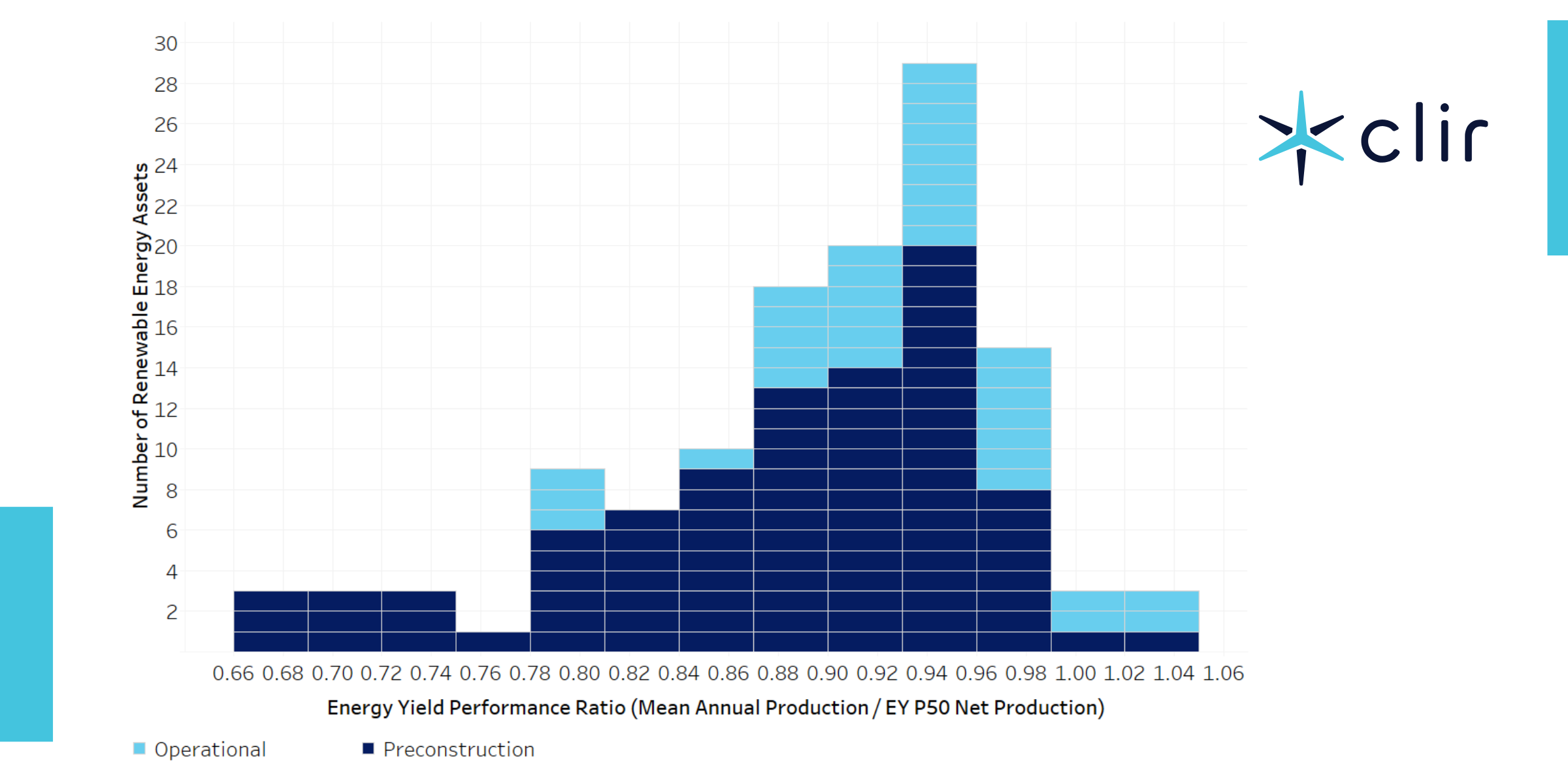
Actual long-term performance/energy yield assessment P50 net production estimate, 124 renewable energy assets. Assets produce more than their preconstruction P50 estimate over the long-term very rarely. Median underproduction is about 10%. Clir's data breaks this down further by technology, region, vintage, organization, and more.
At the operational stage, owners have no choice but to deal with reality. At the preconstruction stage, the incentive to fix it has never been strong enough. Clir regularly looks at preconstruction forecasts for clients considering buying an asset and the numbers are visibly juiced. Wind farms almost never hit them over the long-term. Solar is a slightly different case but the same pattern applies.
There are over 100 different solutions on the market for improving production at wind and solar assets, and Clir maintains a validation database to assess them. Most of the credible ones land in the 1 to 2% range. Owners can sometimes stack them and the benefits are real. None of them close a 10% gap on their own. Drew sees the bigger lever as transparency.
"Going back nine years, one of the big problems we were seeing in the industry was that owners often just didn't really know what was going on at their wind farms," he said.
Larger assets tend to have better reporting, smaller ones often don't, and in either case owners frequently don't see where they're losing energy. A clean view of where energy is going is valuable. Technical assumptions are the financial model, and they don't belong in a back-office spreadsheet.
How Clir’s AI Platform Brings It All Together
Clir is an AI platform that takes data off wind, solar and battery storage assets globally, then enriches it through AI to provide software solutions to stakeholders across the asset lifecycle. As Gareth puts it, Clir holds "the largest operational codified dataset on the planet," with the platform deployed across over 350 GW of assets.
The platform sees data across the full spectrum that owners deal with: catastrophic risk through Clir's insurance work, granular performance through SCADA and the operational context that lives in board packs, monthly reports and daily site logs. Each stream on its own is incomplete.
Insurance data is broad and great for low-frequency catastrophic events, less useful for the 1 to 2% attritional losses. SCADA is granular but missing context. Operational reports add the context but are unstructured. Bringing them together is what makes the platform useful on day one for an owner who plugs in a 100 MW wind farm in Texas and wants to know what to pay attention to.
Drew remembers what that looked like for early Clir customers.
"Some of our early clients said, oh this is great, this is awesome. We thought this would take you guys a year to build. We've been asking our service providers to build something like this for us for years and they haven't done it."
The reach of useful data is also expanding. Clir tracks jack-up barge movements to benchmark intervention rates in offshore wind.
Drones, robotics and new sensor streams are coming online. Every new data source becomes another input to the same question every owner is asking, in development, in operations and in refinancing: where do I look when there’s a problem, what do I look for when I’m there, and how do I fix it.
Clir began working with its first customers on the 1st of January 2017. As Gareth describes it, the founding mission was "grandiose": minimize humankind's impact on the climate by turning renewable energy data into action.
From a small startup out of Vancouver, BC, Clir has grown into a global enterprise by staying close to the pain points owners actually feel. The company started with equity holders. It is now deploying across insurers, off-takers, lenders, developers and service providers.
And with the rollout of data centers signing PPAs against wind and solar assets, Clir is also well-positioned to serve corporate offtakers for the Apples, Walmarts, and Targets of the world.
These buyers face the same contractual availability and performance monitoring questions on the buy side of a PPA that owners face on the sell side. As Gareth put it, the engine behind it is the same. Owners and counterparties are asking similar questions. Clir's job is to make sure they can answer them with the same intelligence.
The renewables industry has scaled faster than the tools that manage it. The assumptions that worked at 100 MW don't survive at 10 GW.
And the technical assumptions that everyone leans on at preconstruction don't survive contact with operational reality. Clir was built to give owners better answers to those questions. The companies that win the next decade in renewables will be the ones who get the technical assumptions right, because everything financial follows from there.
Listen to the full interview on the Watts Up Renewables podcast.