What is Clir's Artificial Intelligence Layer?
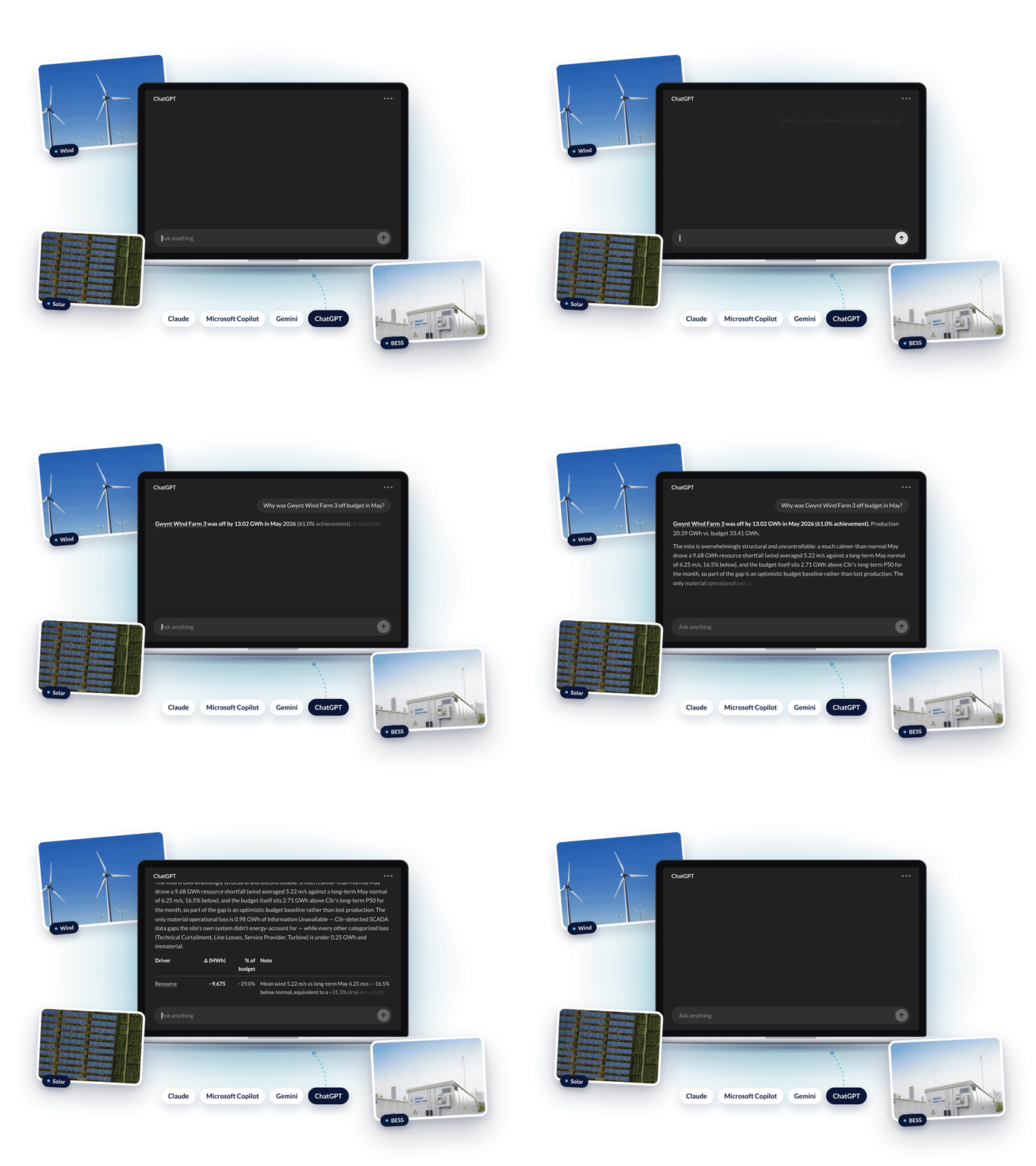
Clir's AI Layer is a three-layer framework that structures renewable energy operational data, runs machine learning and physical models against it and exposes the resulting analytics inside any AI assistant through an open protocol called the Model Context Protocol (MCP). It connects Clir's analytical platform to whatever AI tool a team already uses, reducing days of manual reporting preparation to a conversation.
What can renewable energy teams do with Clir's AI Layer in their own AI tool?
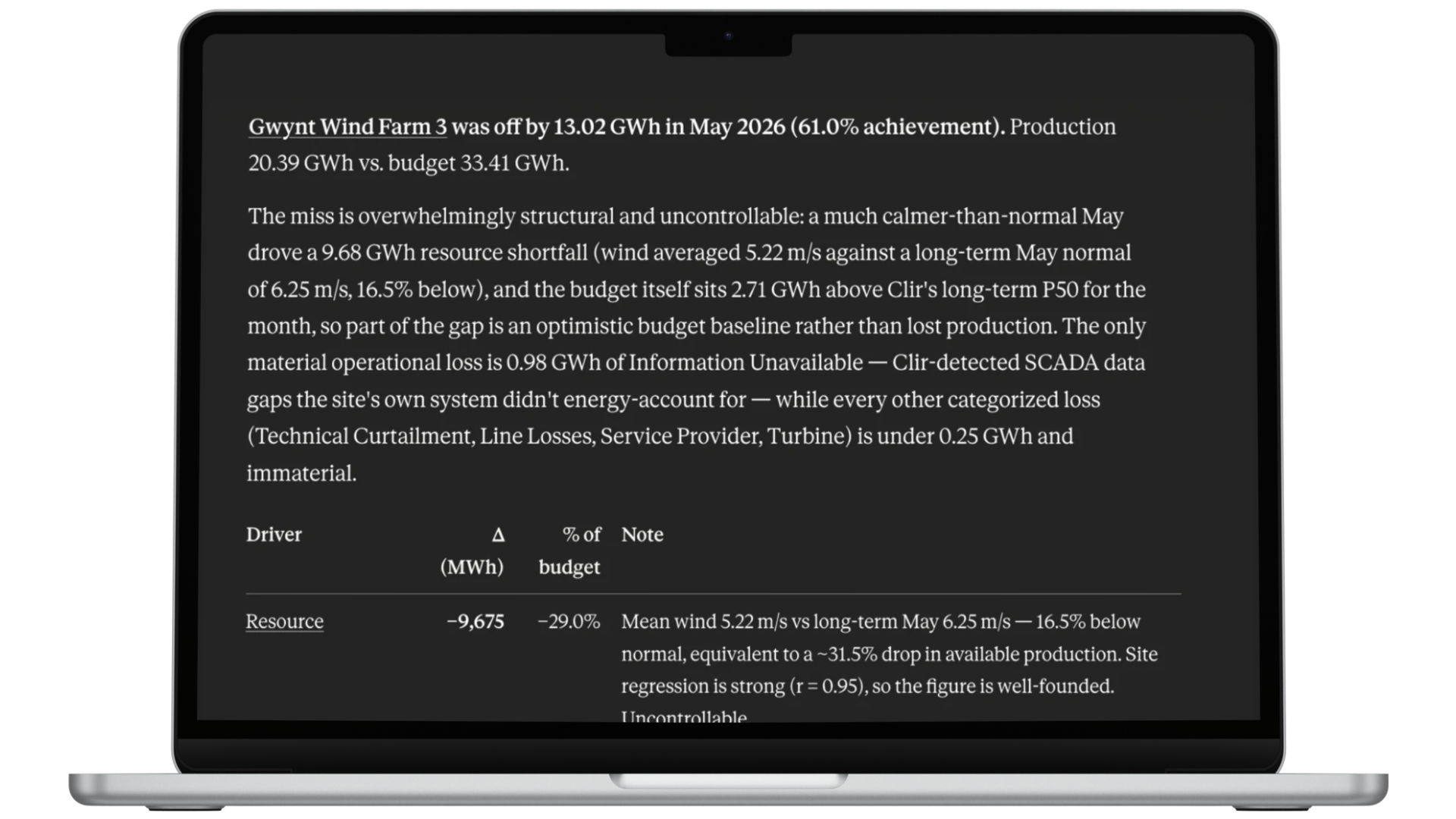
Investor-grade portfolio reporting: Ask for variance commentary, performance summaries or cross-portfolio benchmark comparisons, ready for a board pack.
Contractual availability reconciliation: Ask for an availability figure for a specific OEM, reconciled against that contract's exact definitions, defensible enough to put in a dispute.
Portfolio performance monitoring: Ask for the week's top anomaly recovery actions, ranked by expected MWh recovery, turned into field-ready instructions in minutes.
Budget reconciliation: Ask for a reforecast of long-term yield with updated loss factors and uncertainty assumptions, in time to actually act on it.
Every answer links straight back into the Clir platform, so any finding can be verified against the underlying data. Clir stays your system of record. The assistant is simply the fastest way in.
Built for the people who carry the decisions
Asset Managers
Run faster reporting cycles, hold service providers accountable with independent availability data and surface anomalies without manual data preparation. A site manager opening Monday's data gets an immediate picture of what happened overnight, what to pay attention to and how to plan the day.
Investment Managers
Prepare for board meetings, validate operator narratives and track performance across a portfolio without relying on operator-sourced reporting. An investment manager facing a 100-page offshore wind board pack 48 hours out can surface the key technical assumptions, risks and opportunities before the conversation starts.
What makes Clir's AI different?
It's tempting to assume any team could wire their own AI assistant to their data and get the same result. They can wire it up in a weekend. However, the answers won't hold. The difference between Clir and the alternatives isn't the AI; it's everything that has to be true before the AI answers:
The data is codified, contract by contract.
SCADA data, contractual terms, OEM communications and service reports are structured and aligned before any model runs. A hundred sites means a hundred different definitions of availability and loss and aligning each one to its specific contract is slow, expert work that doesn't transfer between portfolios and can't be prompted into existence. It's the step a generic AI skips and an internal build underestimates.
The predictive layer sits on a baseline that’s hard to acquire.
Clir's forecasts and benchmarks run against 350+ GW of operational data across wind, solar and battery storage. A model trained only on your own portfolio can compare you to yourself; it can't tell you whether a gearbox failure rate is normal across the fleet, because it has never seen the fleet.
The intelligence is yours alone, and it compounds.
The model trains on your specific contracts, OEMs and operational history, getting more accurate every reporting cycle and is never shared with another Clir client. The gap with anyone starting later only widens.
The connection is open; the foundation is not.
Clir uses the open Model Context Protocol so it works with any assistant but the protocol is the commodity. Anyone can stand up a server. What makes Clir's valuable is the two layers beneath it. Anyone can copy the connector. No one can copy what it's connected to.
How does Clir's three-layer AI architecture work?
Clir's AI Layer is structured across three sequential layers. Each layer depends on the one beneath it. All three are needed to create a seamless experience of data intelligence baked right into the owners’ tech stack that their team can easily use.
Layer 1: Data Foundation
SCADA systems report what is happening at a wind, solar or BESS asset. They do not report why. A turbine going offline appears in SCADA as a status code. The reason it went offline lives in field reports, inspection notes and OEM communications outside the SCADA system entirely.
Clir's data layer closes that gap. AI-driven extraction pipelines ingest daily reports, weekly summaries, board packs, OEM communications and operational notes, structuring them and aligning them with live SCADA data so that every event carries the contextual story of what happened on site.
Clir manages extraction reliability through an ensemble approach across multiple AI models, with results flagged for review by Clir's data engineering and renewables expert teams when confidence is low.
One hundred sites means one hundred different contractual definitions of availability and loss factors. The codification work that aligns those definitions to each specific contract is what makes every downstream output accurate and defensible.
Layer 2: Predictive Intelligence
Once data is codified, machine learning and physical models run against it. Clir's predictive layer produces energy yield forecasts, component failure predictions, performance benchmarks and long-term budget reforecasts. Every result runs against an industry baseline drawn from 350+ GW of operational data across wind, solar and battery storage, giving each client's findings the comparative context their own data alone cannot produce.
Predictive accuracy improves with each reporting cycle. The model trains on the client's specific operational patterns, contracts and OEM history, making the intelligence layer more accurate over time.
Layer 3: AI Assistant Integration
Most renewable energy teams already have a corporate AI deployed: Copilot, Claude, ChatGPT or another assistant. Clir's MCP server connects each client's codified data and predictive models to whichever of those tools their team uses.
When a team member asks their AI assistant a question about their portfolio, the assistant calls the Clir MCP server, retrieves the relevant analysis and delivers the result directly into the conversation. No custom integration needed for each tool.
Every AI response includes deep links back into the Clir platform so analysts can verify findings and examine underlying data at any point. Clir remains the system of record, and the AI assistant is a fast-tracked, conversational interface into it.
Frequently Asked Questions
What is the Model Context Protocol (MCP)?
The Model Context Protocol is an open, industry-standard protocol that provides a single secure interface allowing any AI assistant to connect to external data sources and capabilities. It works the same way regardless of which AI assistant is used, eliminating the need for a custom integration for each tool. Clir's MCP server uses this protocol to connect its analytics platform to Claude, Microsoft Copilot, Gemini, ChatGPT and other AI assistants.
Which AI assistants does Clir's MCP server support?
Clir's MCP server is compatible with any AI assistant that supports the Model Context Protocol, including Claude (Anthropic), Microsoft Copilot (Microsoft), Gemini (Google) and ChatGPT (OpenAI).
Is a client's data shared with other Clir clients?
No. Contextual model tuning performed on a client's operational patterns and financial structures is proprietary to that client and is not shared with other clients. Each client's intelligence layer trains exclusively on their own data, contracts and operational history.
What data does Clir's AI draw from?
Clir's AI draws from a structured foundation built from each client's SCADA data, contractual terms, OEM communications, service reports and operational documentation. This is combined with Clir's industry baseline of 350+ GW of operational data from wind, solar and battery storage assets across the world and from every major OEM in the market.
How does Clir ensure accurate extraction from unstructured documents?
Clir uses an ensemble approach, running each extraction through multiple AI models simultaneously and identifying convergence across the results. High-confidence answers emerge from agreement across the ensemble. Extractions without clear convergence are flagged for review by Clir's data engineering and renewable energy expert teams, who provide continuous oversight of the workflow.
What does deploying Clir's AI Layer involve?
Deployment begins with the data foundation: ingesting and structuring operational data, aligning SCADA with unstructured sources and codifying contractual availability definitions and loss factors. Predictive models run once the data foundation is in place. The MCP server then connects the platform to the client's existing AI assistant. The intelligence layer compounds in accuracy with each subsequent reporting cycle.
Book a demo
Leverage AI to unlock actionable intelligence for your renewable energy investments.
- Investor Grade Portfolio Reporting
- Contractual Availability Reconciliation
- Portfolio Performance Monitoring
- Budget Reconciliation
©2026 Clir Renewables. All rights reserved. Privacy Policy.